| M230044 | |
| Pharmaceuticals | |
| 2.0 cm | |
| 90.0 % < 120.0 µm | |
| 30.0 ml | |
| We recommend using a Planeten-Monomühle PULVERISETTE 6 classic line or a Vibratory Micro Mill PULVERISETTE 0 for comminution. |
|
|
Planetary Mono Mill PULVERISETTE 6 classic linespeed: 500 revolutions per minute |
|
| Equipment: |
type of grinding bowl: Grinding bowl 80 ml material: Hardened stainless steel number of grinding balls: 5 x grinding balls: 20 mm dia. grinding balls |
|
|
|
dry grinding of sample A1
|
|
|
|
7 g | |
|
|
10 mm | |
|
|
1 min | |
|
|
(sticking) d50 < 20 µm | |
|
|
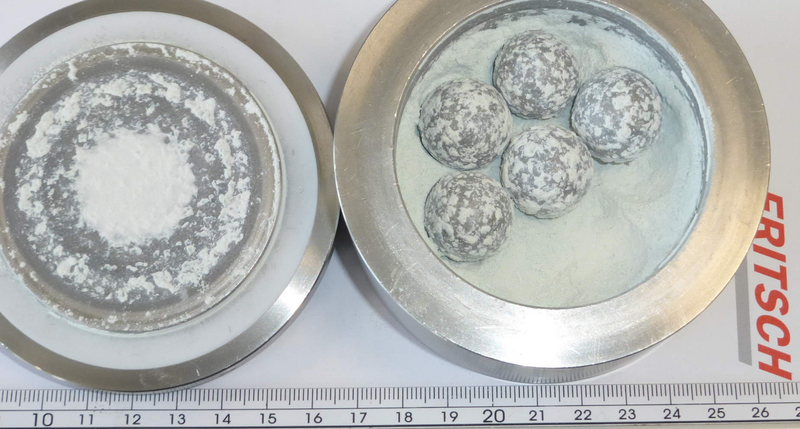
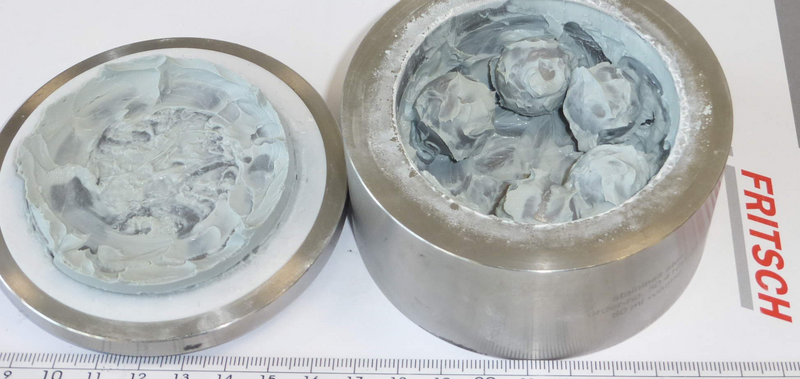
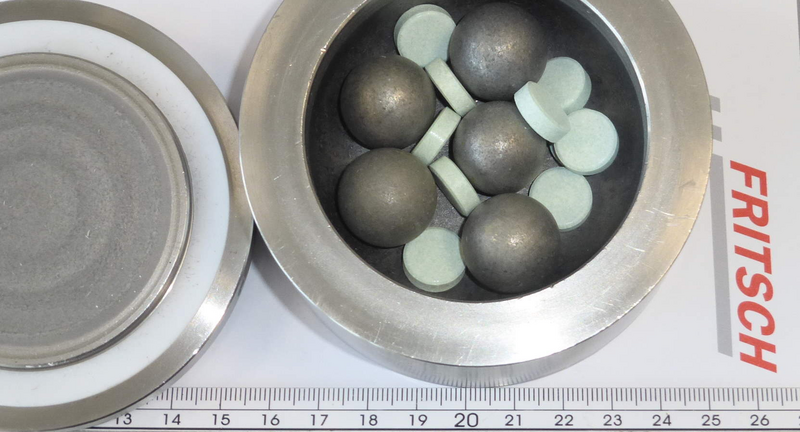
Tablets are often made from highly compressed fine particles. The finer the starting materials, the more robust and stable the resulting tablet becomes. We assume that the primary particles already have a fineness of d50 < 20 µm and, during dry grinding, are rapidly comminuted by the grinding balls and re-compacted. To further reduce the particle size, they should then be additionally ground in suspension. We used 1 pack of A1 tablets (~7 grams) and placed it into the desired 80 ml steel grinding bowl, which was equipped with 5 grinding balls of 20 mm Ø. In pharmaceutical sample preparation, mineral materials (e.g. agate) or ceramic materials (e.g. zirconium oxide) are often used for grinding. Despite the reduced speed (500 rpm), all tablets were crushed within one minute, and the powder was re-compacted by the grinding balls. To further reduce the primary particles, wet grinding in suspension is recommended (see Result 02). Most of the sample could be brushed out. Approximately 0,4 g of the sample adhered more strongly to the grinding balls and the inner wall of the bowl and could not be brushed off. The residues could be easily removed with hot water; a typical short grinding of sand with some water for cleaning was not necessary. |
|
| Pictures: | Start conditions with sample A1. |
|
| Strong sticking of sample after one minute with reduced speed (only 500 rpm). |
|
|
|
|
Planetary Mono Mill PULVERISETTE 6 classic linespeed: 650 revolutions per minute |
|
| Equipment: |
type of grinding bowl: Grinding bowl 80 ml material: Hardened stainless steel number of grinding balls: 5 x grinding balls: 20 mm dia. grinding balls |
|
|
|
wet grinding of sample A1
|
|
|
|
7 g | |
|
|
10 mm | |
|
|
4,5 g2-propanol | |
|
|
(intervals of 30 s) 2 min | |
|
|
majority < 20 µm | |
|
|
With our second trial, we wanted to demonstrate a grinding in suspension. We used the second A2 sample and added about 4,5 grams of isopropyl alcohol (for faster evaporation) to the sample.
We ground the sample in small steps of only 30 seconds, followed by 15 seconds of programmed pausing time. The speed was set to 650 rpm to have the maximum g-force for grinding.
After two minutes of total grinding time, the sample was comminuted to a thick paste. More of isopropyl alcohol should be added to maintain a motor oil like viscosity. It is possible to pack the sample in wet form. We dried the sample inside of our incubator; with only 45 °C, reagglomeration was shown. With an optional rotary speed evaporator, the agglomerates should be much softer.
|
|
| Pictures: |
|
|